
CivE - Civic Engagement App

Client: Personal Project

Role: Founder, Lead Designer

Project

Situation

Civic participation among Gen Z and millennials is at historic lows, despite strong interest in social impact. Most young adults struggle to find credible, nonpartisan, and localized content—and lack a clear, intuitive way to engage with issues that affect their communities. Problem: Civic engagement is fragmented, inaccessible, and rarely designed for how young people consume content today.

I led a small team that set out to design a lightweight, mobile-first solution that reduces friction, increases trust, and encourages civic action through personalized, digestible experiences.

Nearly Half of Americans Report No Civic or Political Engagement (From 2018 Study)

A significant portion of people (almost half) reported no civic or political engagement in the past year, while only about one in five were highly engaged. The remaining 35% participated modestly. This suggests that civic engagement is relatively low overall, with a small but notable group of highly active individuals.

Challange

Our research identified three core experience gaps preventing young users from engaging meaningfully with civic platforms—insights that directly informed our persona development and product strategy.:


  1. Lack of local, actionable informationMany young users were motivated to get involved but didn’t know where to begin. They lacked clear guidance on what to do, where to go, or who to trust in their communities.


  1. Outdated and inaccessible civic toolsExisting platforms felt institutional, visually outdated, and cognitively demanding—turning away users who expected modern, intuitive digital experiences.


  1. Passive, unrewarding engagementUsers craved feedback loops. They wanted to follow issues they care about and see how their input or actions contributed to real change.

Alex Wants to Engage but Doesn’t Know Where to Start

Alex, a 22-year-old part-time tutor in Los Angeles, wants to get involved civically but doesn’t know where to start. Overwhelmed by unclear steps and inaccessible information, Alex feels disconnected from the process. Motivated by community solidarity, Alex needs simple, actionable guidance and trustworthy resources to make participation feel achievable.

Resolution

We translated our research insights into a clear design strategy and a compelling value proposition: CivE is a low-barrier platform that empowers young people to discover, share, and engage with civic content at scale.


Our goal was to create an unbiased, easy-to-navigate, and action-oriented environment that fosters meaningful participation, especially around local issues that often feel inaccessible or overlooked.

Onboarding that Builds Confidence and Direction

To address users’ uncertainty around where to start or what issues to follow, we designed a guided onboarding flow that let users select civic interests to personalize their home feed. Clear labels and progress indicators reduced ambiguity and helped users confidently take the first step.


Impact: Post-testing, we added guidance explaining how interest selection curates their experience—helping users understand the value of their input upfront.

Digital Voting Guide that Closes the Feedback Loop

To address the feeling of one-sided civic participation, we created the "VoteOn" feature—an interactive mobile-friendly voter guide. It allowed users to explore, save, and react to local ballot measures, using rating controls to express opinions and see how others in their community were engaging with the same issues.

Impact: The ability to track personal actions (e.g., bookmarking, supporting) helped users feel their civic behavior was visible and meaningful—turning passive interest into informed participation.

Profiles that Make Representatives Visible and Accountable

To build trust and awareness, we designed "MyGov" profiles tailored to each user’s local representative, automatically generated via geolocation. Each profile used a clean card layout to surface key details like voting history, endorsements, and social media activity—making it easier for users to evaluate and follow civic leaders.Impact: By displaying political data in a simplified, digestible format, users could connect issues they care about with the decision-makers influencing them.

Outcome: CivE Turns Civic Intent Into Action

CivE transformed civic intent into action by making engagement feel local, relevant, and achievable.


  • Validated Concept: Resonance testing with Gen Z and millennials confirmed strong appeal—90% said the app made civic participation feel more accessible, and 80% expressed intent to use it to stay informed and involved.


  • Personalized Experience: Users praised the home feed as “motivating” and “the first time civic info felt designed for me.”


  • Empowered Decision-Making: The VoteOn feature boosted confidence, with 70% reporting improved understanding of local issues.


  • Building Trust: MyGov profiles surfaced unknown representatives and mapped policies to people: “I didn’t even know who my rep was—now I know how they vote.”


  • Usability Gains: Strategic design tweaks drove measurable improvements—onboarding clarity increased completion by 40%, while event save confirmations and calendar integration reduced drop-offs.

CivE - Civic Engagement App

Client: Personal Project

Role: Founder, Lead Designer
Project

Situation

Civic participation among Gen Z and millennials is at historic lows, despite strong interest in social impact. Most young adults struggle to find credible, nonpartisan, and localized content—and lack a clear, intuitive way to engage with issues that affect their communities. Problem: Civic engagement is fragmented, inaccessible, and rarely designed for how young people consume content today.

I led a small team that set out to design a lightweight, mobile-first solution that reduces friction, increases trust, and encourages civic action through personalized, digestible experiences.
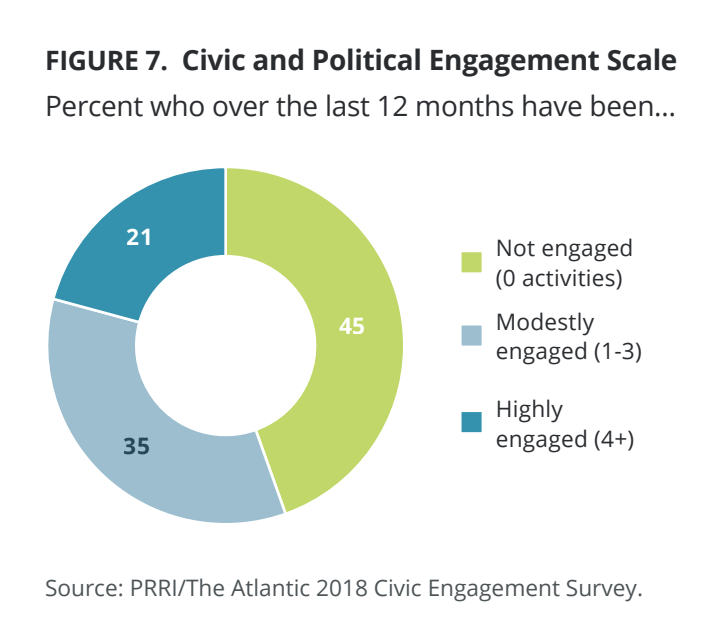
Nearly Half of Americans Report No Civic or Political Engagement (From 2018 Study)

A significant portion of people (almost half) reported no civic or political engagement in the past year, while only about one in five were highly engaged. The remaining 35% participated modestly. This suggests that civic engagement is relatively low overall, with a small but notable group of highly active individuals.

Challange

Our research identified three core experience gaps preventing young users from engaging meaningfully with civic platforms—insights that directly informed our persona development and product strategy.:


  1. Lack of local, actionable informationMany young users were motivated to get involved but didn’t know where to begin. They lacked clear guidance on what to do, where to go, or who to trust in their communities.


  1. Outdated and inaccessible civic toolsExisting platforms felt institutional, visually outdated, and cognitively demanding—turning away users who expected modern, intuitive digital experiences.


  1. Passive, unrewarding engagementUsers craved feedback loops. They wanted to follow issues they care about and see how their input or actions contributed to real change.
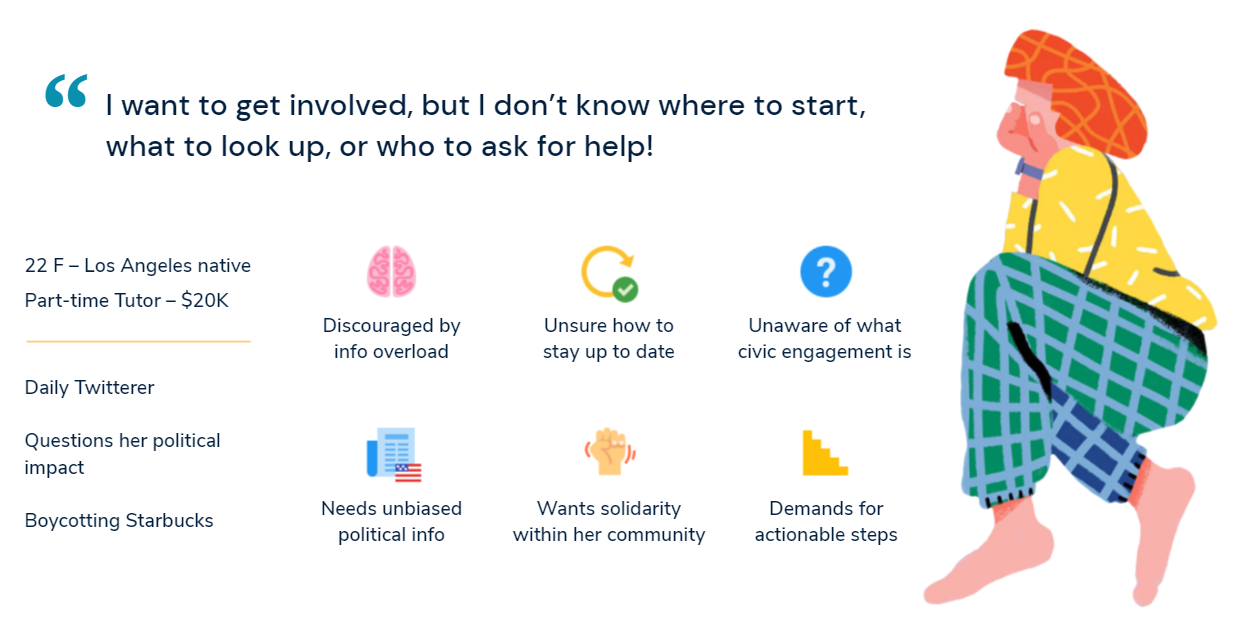
Alex Wants to Engage but Doesn’t Know Where to Start

Alex, a 22-year-old part-time tutor in Los Angeles, wants to get involved civically but doesn’t know where to start. Overwhelmed by unclear steps and inaccessible information, Alex feels disconnected from the process. Motivated by community solidarity, Alex needs simple, actionable guidance and trustworthy resources to make participation feel achievable.

Resolution

We translated our research insights into a clear design strategy and a compelling value proposition: CivE is a low-barrier platform that empowers young people to discover, share, and engage with civic content at scale.


Our goal was to create an unbiased, easy-to-navigate, and action-oriented environment that fosters meaningful participation, especially around local issues that often feel inaccessible or overlooked.

Onboarding that Builds Confidence and Direction

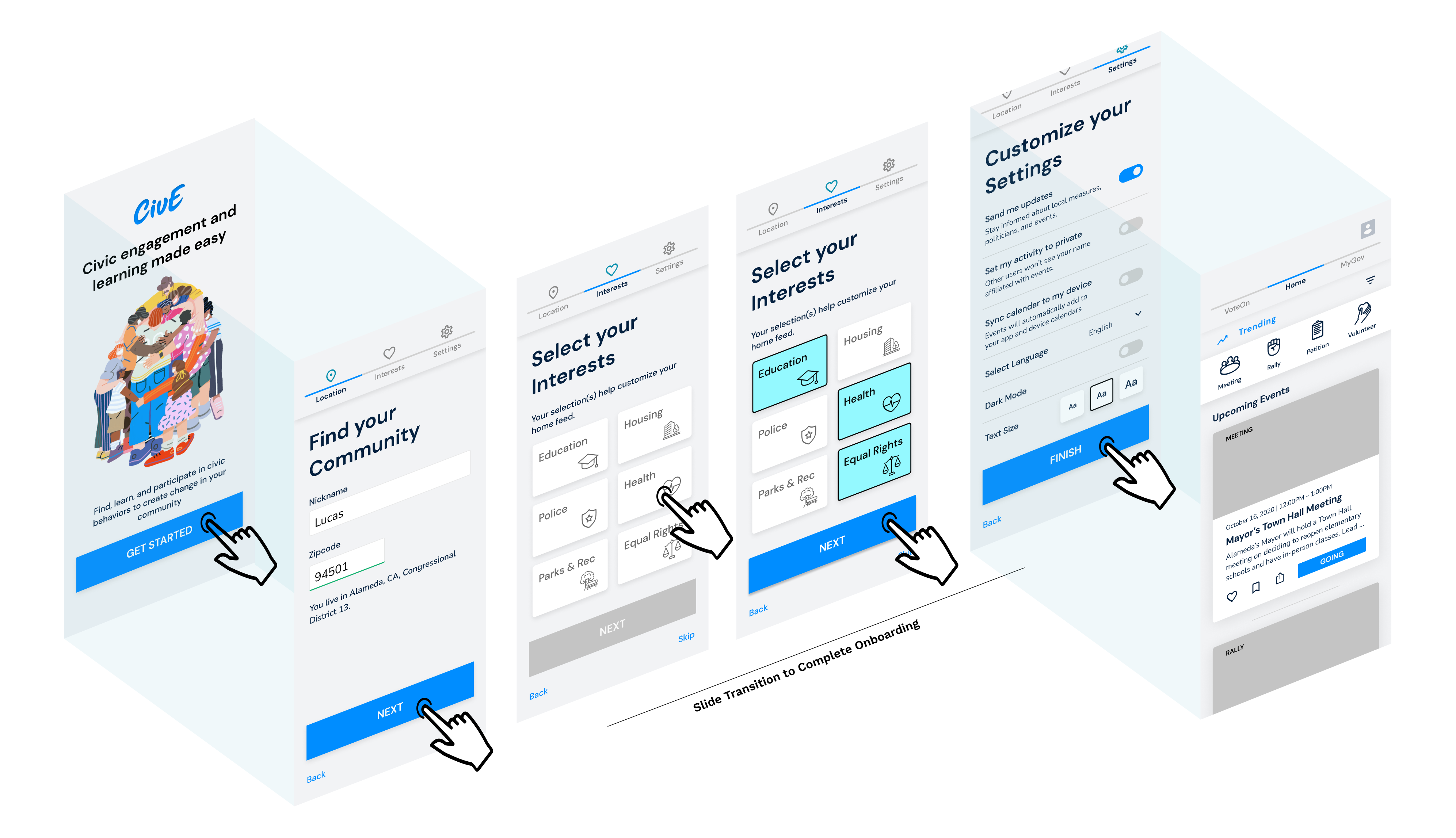
To address users’ uncertainty around where to start or what issues to follow, we designed a guided onboarding flow that let users select civic interests to personalize their home feed. Clear labels and progress indicators reduced ambiguity and helped users confidently take the first step.


Impact: Post-testing, we added guidance explaining how interest selection curates their experience—helping users understand the value of their input upfront.
Digital Voting Guide that Closes the Feedback Loop

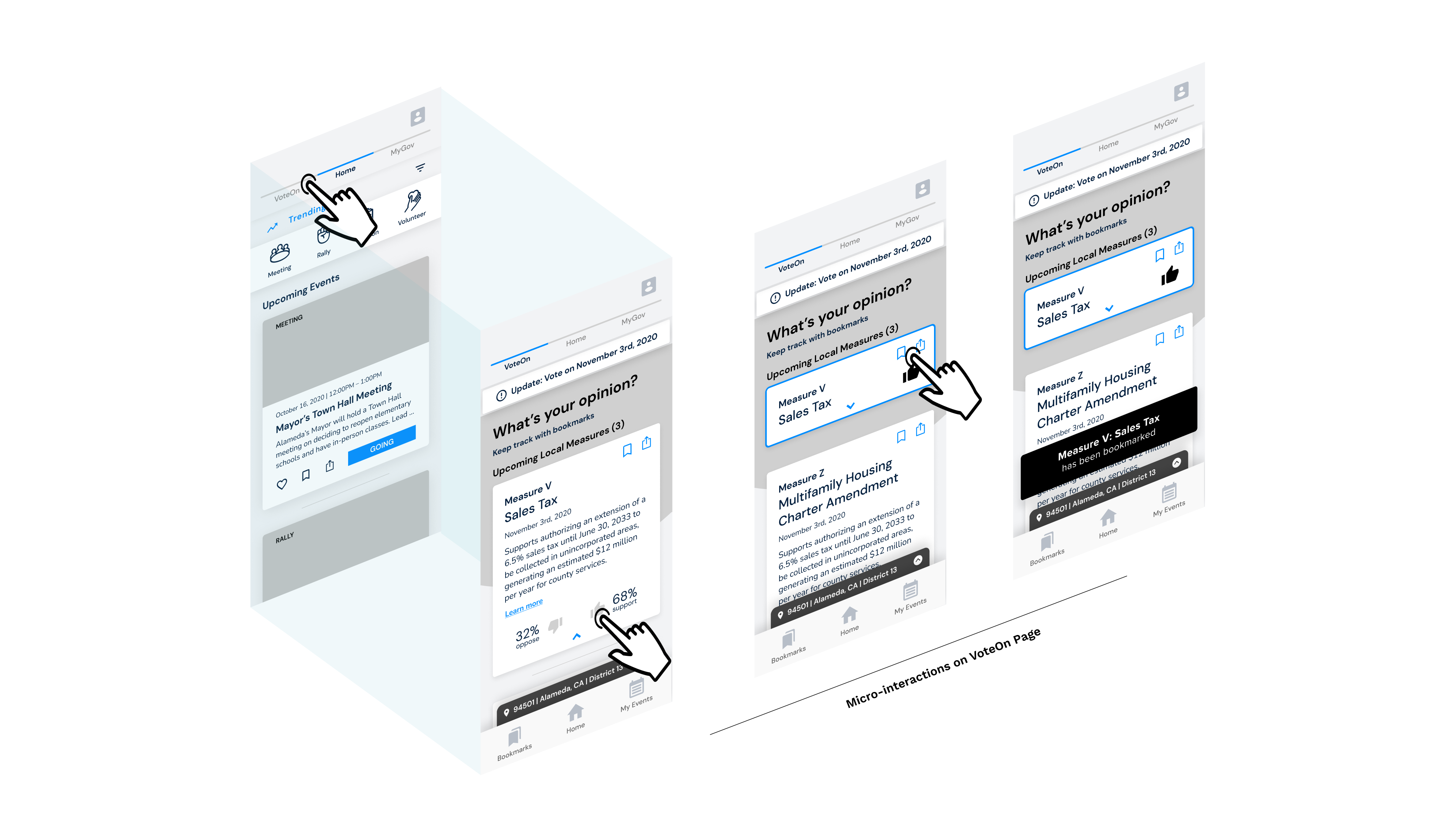
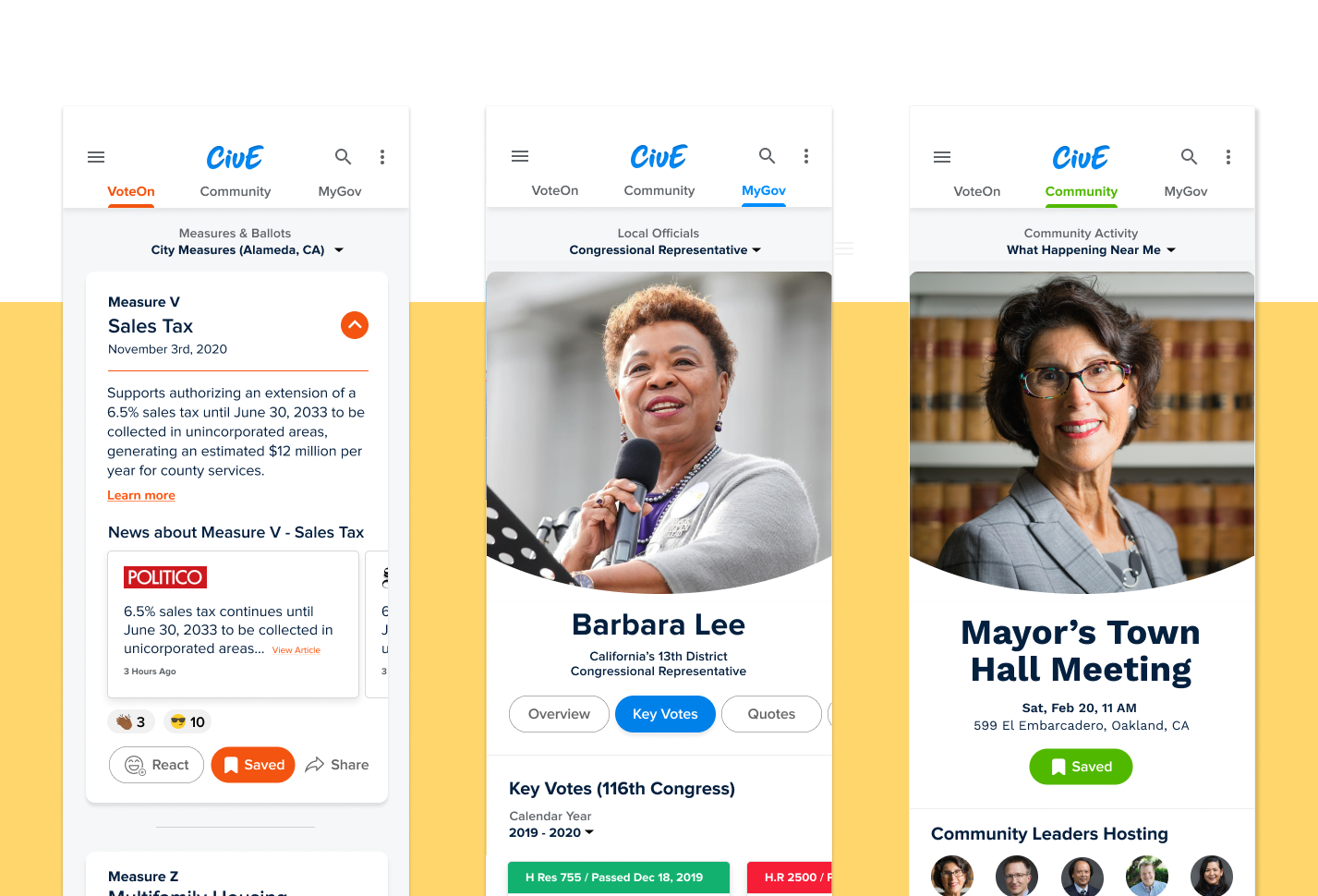
To address the feeling of one-sided civic participation, we created the "VoteOn" feature—an interactive mobile-friendly voter guide. It allowed users to explore, save, and react to local ballot measures, using rating controls to express opinions and see how others in their community were engaging with the same issues.

Impact: The ability to track personal actions (e.g., bookmarking, supporting) helped users feel their civic behavior was visible and meaningful—turning passive interest into informed participation.
Profiles that Make Representatives Visible and Accountable

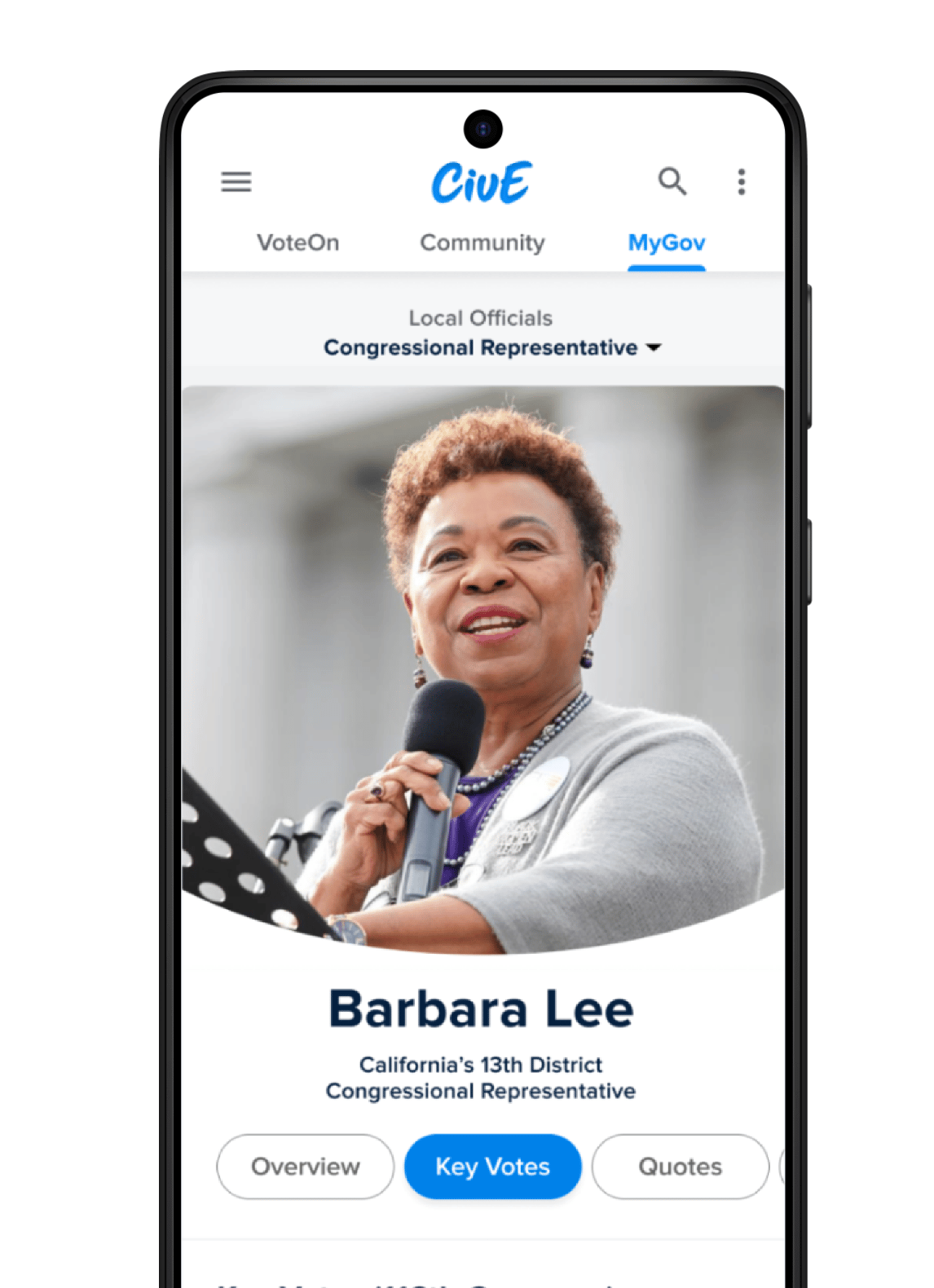
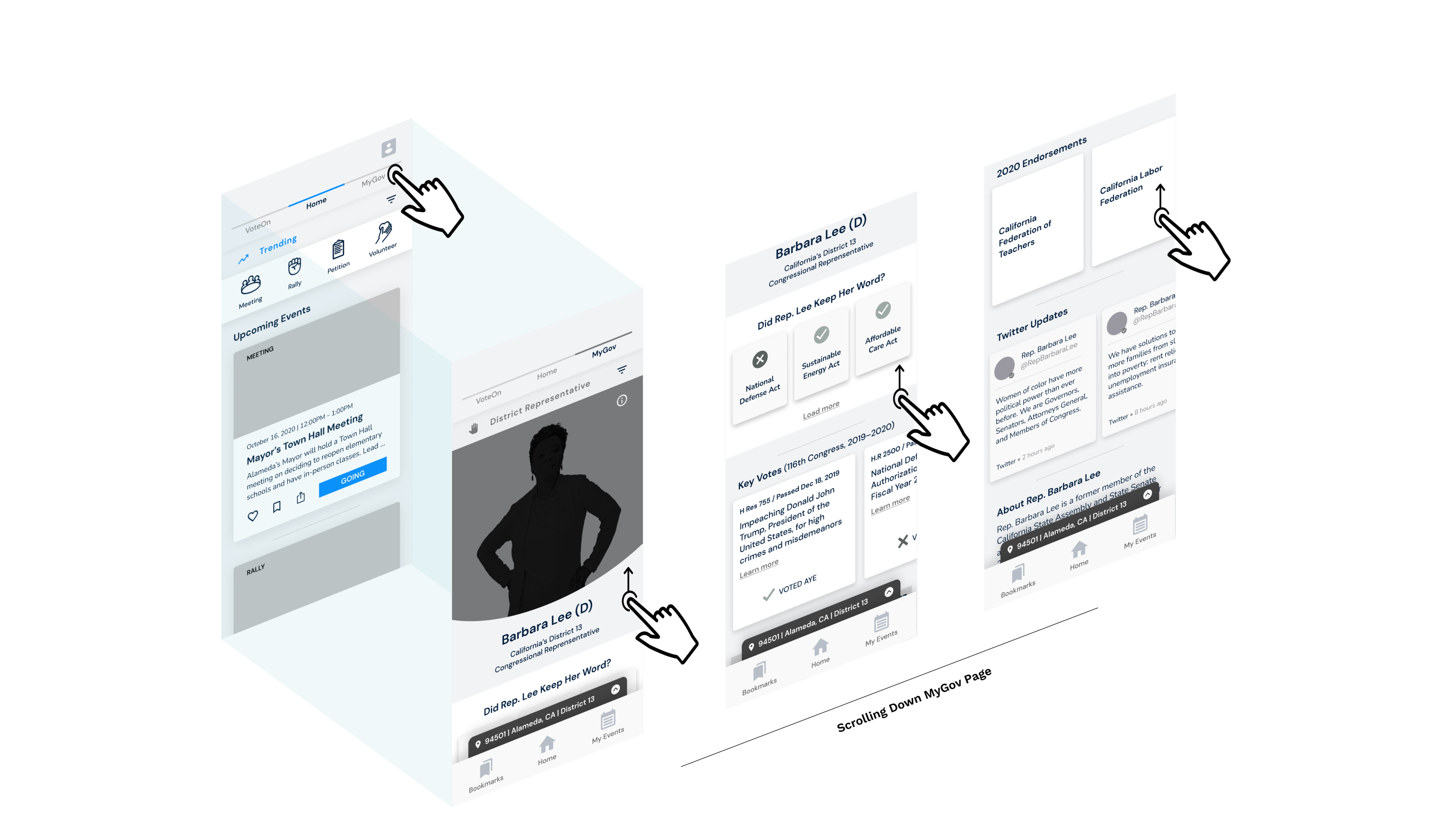
To build trust and awareness, we designed "MyGov" profiles tailored to each user’s local representative, automatically generated via geolocation. Each profile used a clean card layout to surface key details like voting history, endorsements, and social media activity—making it easier for users to evaluate and follow civic leaders.Impact: By displaying political data in a simplified, digestible format, users could connect issues they care about with the decision-makers influencing them.
Outcome: CivE Turns Civic Intent Into Action

CivE transformed civic intent into action by making engagement feel local, relevant, and achievable.


  • Validated Concept: Resonance testing with Gen Z and millennials confirmed strong appeal—90% said the app made civic participation feel more accessible, and 80% expressed intent to use it to stay informed and involved.


  • Personalized Experience: Users praised the home feed as “motivating” and “the first time civic info felt designed for me.”


  • Empowered Decision-Making: The VoteOn feature boosted confidence, with 70% reporting improved understanding of local issues.


  • Building Trust: MyGov profiles surfaced unknown representatives and mapped policies to people: “I didn’t even know who my rep was—now I know how they vote.”


  • Usability Gains: Strategic design tweaks drove measurable improvements—onboarding clarity increased completion by 40%, while event save confirmations and calendar integration reduced drop-offs.

CivE - Civic Engagement App

Client: Personal Project

Role: Founder, Lead Designer

Project

Situation

Civic participation among Gen Z and millennials is at historic lows, despite strong interest in social impact. Most young adults struggle to find credible, nonpartisan, and localized content—and lack a clear, intuitive way to engage with issues that affect their communities. Problem: Civic engagement is fragmented, inaccessible, and rarely designed for how young people consume content today.

I led a small team that set out to design a lightweight, mobile-first solution that reduces friction, increases trust, and encourages civic action through personalized, digestible experiences.

Nearly Half of Americans Report No Civic or Political Engagement (From 2018 Study)

A significant portion of people (almost half) reported no civic or political engagement in the past year, while only about one in five were highly engaged. The remaining 35% participated modestly. This suggests that civic engagement is relatively low overall, with a small but notable group of highly active individuals.

Challenge

Our research identified three core experience gaps preventing young users from engaging meaningfully with civic platforms—insights that directly informed our persona development and product strategy.:


  1. Lack of local, actionable informationMany young users were motivated to get involved but didn’t know where to begin. They lacked clear guidance on what to do, where to go, or who to trust in their communities.


  1. Outdated and inaccessible civic toolsExisting platforms felt institutional, visually outdated, and cognitively demanding—turning away users who expected modern, intuitive digital experiences.


  1. Passive, unrewarding engagementUsers craved feedback loops. They wanted to follow issues they care about and see how their input or actions contributed to real change.

Alex Wants to Engage but Doesn’t Know Where to Start

Alex, a 22-year-old part-time tutor in Los Angeles, wants to get involved civically but doesn’t know where to start. Overwhelmed by unclear steps and inaccessible information, Alex feels disconnected from the process. Motivated by community solidarity, Alex needs simple, actionable guidance and trustworthy resources to make participation feel achievable.

Resolution

We translated our research insights into a clear design strategy and a compelling value proposition: CivE is a low-barrier platform that empowers young people to discover, share, and engage with civic content at scale.


Our goal was to create an unbiased, easy-to-navigate, and action-oriented environment that fosters meaningful participation, especially around local issues that often feel inaccessible or overlooked.

Onboarding that Builds Confidence and Direction

To address users’ uncertainty around where to start or what issues to follow, we designed a guided onboarding flow that let users select civic interests to personalize their home feed. Clear labels and progress indicators reduced ambiguity and helped users confidently take the first step.


Impact: Post-testing, we added guidance explaining how interest selection curates their experience—helping users understand the value of their input upfront.

Digital Voting Guide that Closes the Feedback Loop

To address the feeling of one-sided civic participation, we created the "VoteOn" feature—an interactive mobile-friendly voter guide. It allowed users to explore, save, and react to local ballot measures, using rating controls to express opinions and see how others in their community were engaging with the same issues.

Impact: The ability to track personal actions (e.g., bookmarking, supporting) helped users feel their civic behavior was visible and meaningful—turning passive interest into informed participation.

Profiles that Make Representatives Visible and Accountable

To build trust and awareness, we designed "MyGov" profiles tailored to each user’s local representative, automatically generated via geolocation. Each profile used a clean card layout to surface key details like voting history, endorsements, and social media activity—making it easier for users to evaluate and follow civic leaders.Impact: By displaying political data in a simplified, digestible format, users could connect issues they care about with the decision-makers influencing them.

Outcome: CivE Turns Civic Intent Into Action

CivE transformed civic intent into action by making engagement feel local, relevant, and achievable.


  • Validated Concept: Resonance testing with Gen Z and millennials confirmed strong appeal—90% said the app made civic participation feel more accessible, and 80% expressed intent to use it to stay informed and involved.


  • Personalized Experience: Users praised the home feed as “motivating” and “the first time civic info felt designed for me.”


  • Empowered Decision-Making: The VoteOn feature boosted confidence, with 70% reporting improved understanding of local issues.


  • Building Trust: MyGov profiles surfaced unknown representatives and mapped policies to people: “I didn’t even know who my rep was—now I know how they vote.”


  • Usability Gains: Strategic design tweaks drove measurable improvements—onboarding clarity increased completion by 40%, while event save confirmations and calendar integration reduced drop-offs.